– see vector file – The “.svg” extension is linked to the SVG format, created by the W3C, the organization that defines web standards. It is a vector format based on text (XML): shapes are described by commands, not by pixels. SVG images do not depend on resolution and keep their quality when enlarged or reduced. It allows for quality printing, much like “.ai“, “.eps” and “.pdf” file formats.
Weaving is the process of interlacing threads to obtain a fabric. The warp threads are stretched on the loom. The weft threads pass between them, above and below, in a precise order. This order is the armor. Three basic weaves make it possible to create almost any fabric: canvas, twill and satin. The weaving of our fabrics is done in Spain, in our partner factory, from spools of thread.
More information on the technical manufacturing page.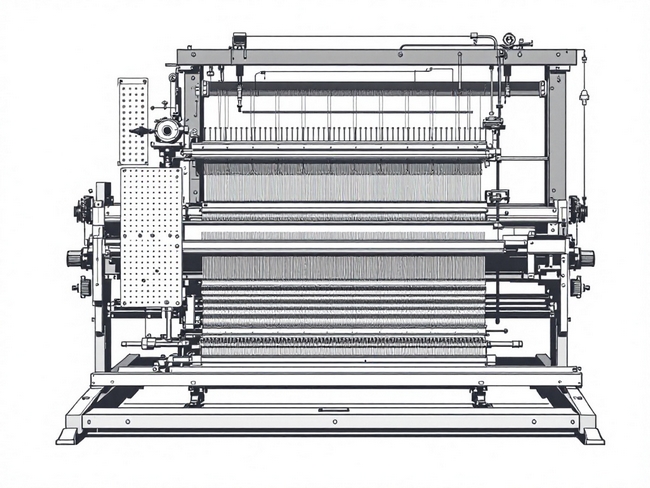
PPWR stands for Packaging and Packaging Waste Regulation, Regulation (EU) 2025/40 on packaging and packaging waste. It entered into force on 11 February 2025, applies since 12 August 2026, and replaces Directive 94/62/EC. It harmonises packaging rules across the European Union, including the future harmonised sorting label that will take over from national pictograms such as the Triman.
A knockout is a part or a text reversed out of one or more ink layers. In practice, it is an area the ink will not touch. On a pouch printed with a solid colour, a logo left in knockout stays the colour of the fabric. The contrast comes from the fabric itself, not from an extra ink. It is an elegant, sober effect, often used on ecru cotton fabric packaging: a coloured background, the logo in the natural shade of the fabric. A knockout saves one printing colour while keeping a clean result.
A plotter is a computer-controlled machine. It draws or cuts the pattern pieces directly into the fabric, from the production file. The result is clean and identical from one piece to the next.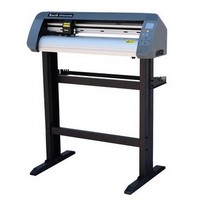
The portrait format is a format whose largest dimension is the height. It is the most common format for pouches: a bottle, a perfume bottle, a pair of shoes are vertical objects. The pouch follows the line of the product, which gives a clean drape and a natural closure at the top. Stating the orientation of the format in your quote request avoids misunderstandings: width × height, in that order, remains the safest convention. Conversely, when the largest dimension is the width, the format is called landscape.
The landscape format is a format whose largest dimension is the width. It suits objects that are wider than they are tall: a leather bag, flat boxes, products laid out lengthwise. It is also the format of wide visuals, such as a horizontal logo printed large on a bag. For printing, the orientation of the design across the fabric width changes the number of placements available, and therefore the yield. A simple rotation of the format (portrait format) can save material on a whole run.
A sleeve is a fabric packaging with both ends left open. The product slides in through one of the two openings and may protrude from the other. It is the simplest packaging there is: a tube of fabric, cut to the right length. No cord, no bottom seam. The sleeve protects by wrapping. It suits elongated objects well: bottles, tubes, instruments, mechanical parts. It slips on and off in seconds, which makes it practical in the workshop or in logistics. In cotton or non-woven fabric, it is also an economical textile packaging to produce.
Overs and unders are the quantity produced and delivered over or under the ordered quantity, within the manufacturing tolerance. As long as this difference stays within the percentage accepted by trade practice, the customer accepts it: the invoice follows the quantity actually delivered.
For the French market, the “Triman” pictogram, together with sorting information, is mandatory on all products covered by a sorting instruction.
The French AGEC law (anti-waste for a circular economy law), in its implementing decree no. 2021-385 of 29 June 2021, sets out how the “Triman” logo and the “sorting instructions” must be used.
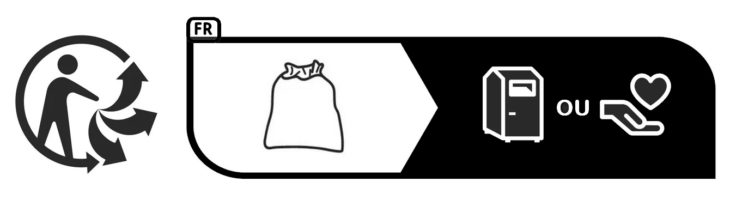
Since August 2026, the European PPWR regulation has introduced a harmonised sorting label for the whole European Union, which will take over from national pictograms from August 2028.


